| malloc() |
free() |
C函数 |
不可 |
| new |
delete |
C++表达式 |
不可 |
| ::operator new() |
::operator delete() |
C++函数 |
可 |
| allocator::allocate()
| allocator::deallocate()
| C++标准库 |
可自由设计并与之搭配任何容器 |
#include <iostream>
#include <complex>

using namespace std;

int main() {

	void* p1 = malloc(521);
	free(p1);

	complex<int>* p2 = new complex<int>;
	delete p2;

	void* p3 = ::operator new(512);
	::operator delete(p3);

#ifdef _MSC_VER
	// 以下两个函数都是non-static,一定要通过object调用,以下分配3个int空间
	int* p4 = allocator<int>().allocate(3, (int*)0);
    // 上面的 (int*)0 暂时没有用
    // 通过 allocator<int>() 创建要给临时对象,执行临死对象的allocate方法
	allocator<int>().deallocate(p4, 3);
    // 通过 allocator<int>() 创建要给临时对象,执行临死对象的deallocate方法
#endif // _MSC_VER
#ifdef __BORLANDC__
	// 以下两个函数都是non-static,一定要通过object调用,以下分配5个int空间
	int* p4 = allocator<int>().allocator(5);
	allocator<int>().deallocate(p4, 5);
#endif // __BORLANDC__
#ifdef __GNUC__
	// 以下两个函数都是static,可通过全名调用,一下分配512bytes
	void* p4 = alloc::allocate(512);
	alloc::deallocate(p4, 512);
#endif // __GNUC__


	return 0;
}
上述代码为四种内存分配的基本用法
class Complex {
public:
	Complex(int x, int y) {
		m_x = x;
		m_y = y;
		std::cout << "constructor Complex" << std::endl;
	}
	Complex() {
		m_x = 0;
		m_y = 0;
		std::cout << "constructor Complex" << std::endl;
	}

private:
	int m_x;
	int m_y;
};

void func_new() {
	Complex* p1 = new Complex(1, 2);
	delete p1;

    // 等价于
	Complex* p2;
	try
	{
		void* mem = operator new(sizeof(Complex));
		p2 = static_cast<Complex*>(mem);
		p2->Complex::Complex(1, 2);
		operator delete(p2);
        // 这里直接调用构造函数的动作 只有编译器才可以这么写 自己写不同平台可能报错
	}
	catch (std::bad_alloc)
	{

	}
}
tip: 上述代码中说明了不可直接pc->Complex::Complex(1,2)方法,如果想直接调用构造函数可以运用placement new,写法是new(p)Complex(1,2)
// gcc 中 operator new的实现方式
void *operator new(std::size_t size) _THROW_BAD_ALLOC
{
    if (size == 0)
        size = 1;
    void* p;
    while ((p = ::malloc(size)) == nullptr)
    {
        // If malloc fails and there is a new_handler,
        // call it to try free up memory.
        std::new_handler nh = std::get_new_handler();
        if (nh)
            nh();
        else
#ifndef _LIBCPP_NO_EXCEPTIONS
            throw std::bad_alloc();
#else
            break;
#endif
    }
    return p;
}
从上面的代码可以看到,new的实现方式就是调用了operator new方法,在强转之后执行了对应的构造函数
而operator new方法中,真正分配内存的是malloc方法
网上看到的资料
Complex* pc = new Complex(1, 2);
// ... some operation
delete pc;

// 编译器将delete转换成下面操作
pc->~Complex();         // 先析构
operator delete(pc);    // 然后释放内存
上述为delete的操作,这里直接调用析构函数不会报错
void operator delete(void* ptr) noexcept
{
    ::free(ptr);
}
operator delete底层通过free释放内存
上述代码中pc->Complex::Complex(1, 2)直接执行构造函数没有报错,并不能表示我们可以都这么直接调用构造,下面代码就是一个反例
string* pstr = new string;
pstr->string::string();
pstr->~string();
delete pstr;
这里的代码会明显报错class std::basic_string<char> has no member named string
这里报错的原因是string本来的名字其实叫basic_string,是被typedef成string,所以string的构造函数应该是basic_string()才对
除了typedef导致构造函数名字不对的问题之外,编译器的严格程度不同也会出现报错,即存在平台差异性,所以不推荐手动调用构造函数
array new / array delete
Complex* pca = new Complex[3];    // 唤起三次构造函数
// ... some operation
delete[] pca;                     // 唤起三次析构
如果写的是delete而不是delete[],那么编译器只会执行一次析构函数,而不是三次,也就是说有两个对象的析构函数没有执行,如果对象中存在new操作,这样会导致无法执行delete进而导致内存泄漏
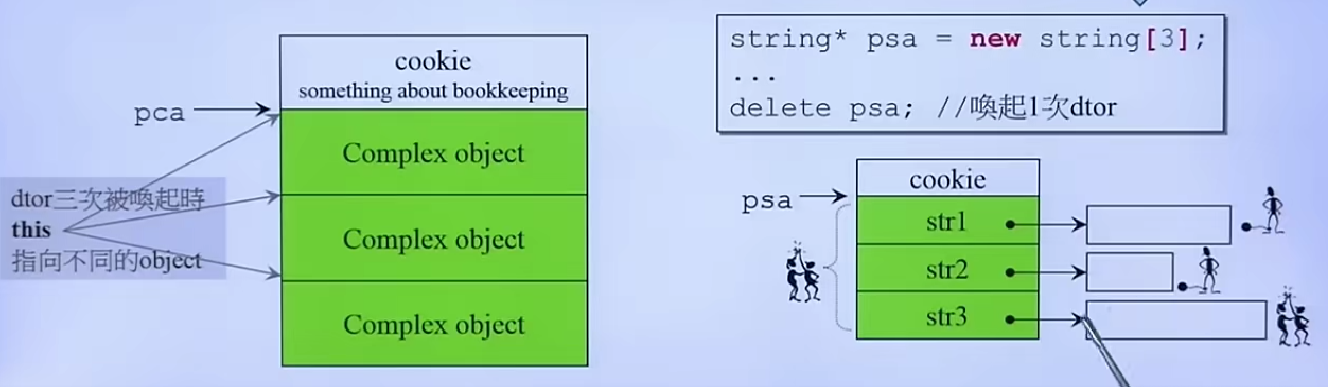
从上图中可以看到,new出的内存块除了包含三个Complex对象外,还包含一些cookie信息,这些信息帮助操作系统释放整块内存,而delete与delete[]区别仅仅在于数组中所有对象是否都执行析构
class A{
public:
    int id;

    A(): id(0) { std::cout << "default " << this << " " << this->id << std::endl; };
    A(int i): id(i) { std::cout << this << " "  << "int cons" << i << std::endl; }
    ~A() { std::cout << " ~ " << this << " "  << this->id << std::endl; }
};

void test_placement_new() {

	A* buf = new A[3];              // 调用A的默认构造函数,创建对象
	A* tmp = buf;

	for (int i = 0; i < 3; i++) {
		new(tmp++)A(i);             // placement new的写法,在tmp地址的构建A对象,调用A的构造函数
	}

	delete[] buf;
}
default 00A64CF4 0
default 00A64CF8 0
default 00A64CFC 0
00A64CF4 int cons0
00A64CF8 int cons1
00A64CFC int cons2
~ 00A64CFC 2
~ 00A64CF8 1
~ 00A64CF4 0
通过查看输出,可以发现这上述代码的执行顺序
placement new
placement new 允许我们将object建构于allocated memory(已经分配的内存)中- 没有
placement delete,因为placement new根本没有分配内存
因为是构建于已经分配的内存中,所以需要一个现成的被分配的内存空间的指针
#include <new>

void func(){
    char* buf = new char[sizeof(Complex) * 3];
    Complex* pc = new(buf)Complex(1, 2);
    // ....
    delete[] buf;
}
void func_1(){
    Complex* pc = new(buf)Complex(1, 2);
    // 上面一行代码 等价下面的代码

    Complex* pc;
    try{
        void* mem = operator new(sizeof(Complex), buf);
        pc = static_cast<Complex*>(mem);
        pc->Complex::Complex(1, 2);
    }
    catch(std::bad_alloc){

    }
}

// 下面为当 operator new的两个参数为size_t和void*的源码
void* operator new(size_t, void* loc){
    return loc;
}
上面的代码使用了 placement new,它可以让你在已经分配好的内存上构造对象。placement new的语法是:new (address) (type) initializer。其中,address 是你指定的内存地址,type 是你要构造的对象的类型,initializer 是你要传递给对象构造函数的参数
定位 new 操作符的优点是可以提高性能和异常安全性,因为它不需要再次分配内存,而且可以在程序员控制的内存上创建对象。定位 new 操作符的缺点是需要手动调用对象的析构函数来释放资源,而且不能使用 delete 操作符来删除对象,只能删除分配给它们的内存。
分析上述代码可以发现
operator new(size_t, void* loc)什么都没做,因为此时loc是已经分配好了的内存地址,所以不需要再分配内存placement new其实就是执行了一次构造函数
C++分配内存的途径

一般来说,我们会重载类的Foo::operator new和Foo::operator delete,将对象的创建和内存分配自己来控制(通过自己控制可以减少内存块上的cookie的使用)
Foo*p = (Foo*)malloc(sizeof(Foo));
new(p)Foo(x);
// ...
p->~Foo();
free(p);
当然也可以重载全局::operator new / ::operator delete
// 测试重写代码

void* myAlloc(size_t size){
    return malloc(size);
}

void myFree(void* ptr){
    return free(ptr);
}

inline void* operator new(size_t size){
    cout << "my new" << std::endl;
    return myAlloc(size);
}

inline void* operator new[](size_t size){
    cout << "my new[]" << std::endl;
    return myAlloc(size);
}

inline void operator delete(void* ptr){
    cout << "my delete" << std::endl;
    myFree(ptr);
}

inline void operator delete[](void* ptr){
    cout << "my delete[]" << std::endl;
    myFree(ptr);
}
更常见的写法是类中重载
class Foo {
public:
	int _id;
	long _data;
	std::string _str;

public:
	Foo() : _id(0) { std::cout << "default ctor " << this << " " << this->_id << std::endl; }
	Foo(int i): _id(i) { std::cout << "ctor " << this << " " << this->_id << std::endl; }

	virtual ~Foo() { std::cout << "dtor " << this << std::endl; }


	static void* operator new(size_t size);
	static void operator delete(void* pdead, size_t size);
	static void* operator new[](size_t size);
	static void operator delete[](void* pdead, size_t size);
};

void* Foo::operator new(size_t size) {
	Foo* p = (Foo*)malloc(size);
	std::cout << "my alloc Foo " << p << std::endl;
	return p;
}

void Foo::operator delete(void* pdead, size_t size) {
	std::cout << "my delete " << pdead << std::endl;
	free(pdead);
}

void* Foo::operator new[](size_t size) {
	Foo* p = (Foo*)malloc(size);
	std::cout << "my alloc Foo " << p << std::endl;
	return p;
}

void Foo::operator delete[](void* pdead, size_t size) {
	std::cout << "my delete " << pdead << std::endl;
	free(pdead);
}

int main() {
	std::cout << sizeof(Foo) << std::endl;

	Foo* p = new Foo(7);
	delete p;

	Foo* pArray = new Foo[5];
	delete[] pArray;
	return 0;
}
40
my alloc Foo 00C2DA78
ctor 00C2DA78 7
dtor 00C2DA78
my delete 00C2DA78
my alloc Foo 00C30110
default ctor 00C30114 0
default ctor 00C3013C 0
default ctor 00C30164 0
default ctor 00C3018C 0
default ctor 00C301B4 0
dtor 00C301B4
dtor 00C3018C
dtor 00C30164
dtor 00C3013C
dtor 00C30114
my delete 00C30110
但是,如果使用::new和::delete则会绕过类定义的operator new / operator delete方法,转而执行全局的new / delete
int main() {
	std::cout << sizeof(Foo) << std::endl;

	Foo* p = ::new Foo(7);
	::delete p;

	Foo* pArray = ::new Foo[5];
	::delete[] pArray;
	return 0;
}
分配内存
Foo* p = new Foo();

delete p;
上述代码等价于下面的代码,原理不再解释
Foo* p = (Foo*)operator new(sizeof(Foo));
new(p) Foo(x);

p->~Foo();
operator delete (p);
operator new 本质上还是调用 malloc 来分配内存,虽然这个过程一般来说很快,但是如果可以减少 malloc 调用的次数,一定程度上可以加快程序运行效率
那么我们可以一开始就分配一个很大的内存,然后切成一个个小块分配给具体的对象,这样就只用 malloc 一次,然后我们手动对内存分块

还有一点就是这样子可以减少 cookie 的量,每一次 malloc 除了分配指定大小的内存之外,还在内存块前后分别额外申请了内存用于存放 cookie,cookie中的信息用于表示内存是否被分配以及分配的大小等信息
cookie 并不是C++语言标准中的术语

如果是一开始自己申请一大块内存,手动切割内存可以减少 cookie 的量,从而提升内存的使用率
基于上面的想法,我们得到了如下的设计
#include <cstddef>
#include <iostream>

class Screen {
public:
	Screen(int x): i(x) {};
	int get() { return i; }

	static void* operator new(size_t);
	static void operator delete(void*, size_t);

private:
	Screen* next;
	static Screen* freeStore;
	static const int screenChunk;

private:
	int i;
};

Screen* Screen::freeStore = nullptr;
const int Screen::screenChunk = 24;

void* Screen::operator new(size_t size)
{
	Screen* p = nullptr;
	if (!freeStore) {
		// linked list 为空 需要申请一大块内存
		size_t chunk = screenChunk * size;
		freeStore = p = reinterpret_cast<Screen*>(new char[chunk]);
		// &freeStore[screenChunk - 1] 表示 freeStore 数组中最后一个 Screen 的内存地址 p 指向最后一个 Screen 时表示遍历结束
		for (; p != &freeStore[screenChunk - 1]; ++p) {
			p->next = p + 1;
		}
		p->next = nullptr;
	}

	p = freeStore;
	freeStore = freeStore->next;
	return p;
}

void Screen::operator delete(void* p, size_t)
{
	(static_cast<Screen*>(p))->next = freeStore;
	freeStore = static_cast<Screen*>(p);
}
int main() {
	std::cout << sizeof(Screen) << std::endl;

	size_t const N = 100;
	Screen* p[N];

	for (int i = 0; i < N; ++i) {
		p[i] = new Screen(i);
	}

	for (int i = 0; i < 10; ++i) {
		std::cout << p[i] << std::endl;
	}

	for (int i = 0; i < N; ++i) {
		delete p[i];
	}

	return 0;
}
在自定义 opeator new 和 operator delete 之前,连续申请100个 Screen,每个对象的地址信息,可见虽然是连续申请的对象,但是地址之间插值并不是 16,可见有 cookie 存在

在使用自定义 operator new 和 operator delete 之后,Screen 对象地址连续,并没有被 Cookie 占用

这里 Screen 使用了链表来连接整个大内存空间中的 Screen 对象
有一个问题就是 Screen 对象中仅仅存在一个 int i 的属性大小是 8 个字节,但是为了自己分配内存空间需要额外定义 Screen* next 指针,指针也占用 8 个字节,浪费了 50% 的空间
为了节省指针导致的内存浪费,可以使用 union 来处理
class Airplane {
private:
	struct AirplaneRep {
		unsigned long miles;
		char type;
	};

private:
	union {
		AirplaneRep rep;	// 指针对使用中的 objects
		Airplane* next;		// 指针对 fire list 中的object
	};

public:
	unsigned long getMiles() { return rep.miles; }
	char getType() { return rep.type; }

	void set(unsigned long m, char t) {
		rep.miles = m; rep.type = t;
	}

public:
	static void* operator new (size_t size);
	static void operator delete (void* deadObject, size_t size);

private:
	static const int BLOCK_SIZE;
	static Airplane* headOfFreeList;
};

Airplane* Airplane::headOfFreeList = nullptr;
const int Airplane::BLOCK_SIZE = 512;

void* Airplane::operator new(size_t size) {
	// 如果大小有误 转交 ::operator new
	if(size!=sizeof(Airplane)) {
		return ::operator new(size);
	}

	Airplane* p = headOfFreeList;
	if (p) {
		headOfFreeList = p->next;
	}
	else {
		// free list 为空 需要申请初始内存
		Airplane* newBlock = static_cast<Airplane*>(::operator new(BLOCK_SIZE * sizeof(Airplane)));

		// 将小块串成 free list
		// 但跳过 #0 因为它将作为本次返回结果
		for (int i = 1; i < BLOCK_SIZE - 1; i++)
		{
			newBlock[i].next = &newBlock[i + 1];
		}
		newBlock[BLOCK_SIZE - 1].next = nullptr;
		p = newBlock;
		headOfFreeList = &newBlock[1];
	}
	return p;
}

void Airplane::operator delete(void* p, size_t size)
{
	if (p == nullptr) {
		return;
	}

	if (size != sizeof(Airplane)) {
		::operator delete(p);
		return;
	}

	Airplane* carcass = static_cast<Airplane*>(p);
	carcass->next = headOfFreeList;
	headOfFreeList = carcass;
}
Airplane 的 sizeof 大小为 8

为了实现自己的内存分配,我们给 Airplane 和 Screen 两个类重写了 operator new 和 operator delete
那么如果我有100个类甚至1000个类又该如何?我们不能给每个类都重写 operator new 和 operator delete 吧?关键是每个类的写法相似,功能相同,所以得想一个办法把自定义内存分配的操作从对象中剥离出来
所以我们需要一个 allocator 分配器对象
#include <cstddef>
#include <iostream>

class MyAllocator {
private:
	struct obj
	{
		struct obj* next;
	};

public:
	void* allocate(size_t);
	void deallocate(void*, size_t);

private:
	obj* freeStore = nullptr;
	const int CHUNK = 5;	// 标准库是20
	const int min_size = 8;
};

void* MyAllocator::allocate(size_t size)
{
	obj* p = nullptr;
	size =  size > min_size ? size : min_size;
	if (!freeStore) {
		size_t chunk = CHUNK * size;
		freeStore = p = (obj*)malloc(chunk);

		if (p == nullptr) {
			return nullptr;
		}

		// 连接内存块
		for (int i = 0; i < CHUNK - 1; ++i) {
			p->next = (obj*)((char*)p + size);
			p = p->next;
		}

		p->next = nullptr; // last
	}
	p = freeStore;
	freeStore = freeStore->next;
	return p;
}

void MyAllocator::deallocate(void* p, size_t)
{
	// 将 p 收回插入 free list 前端
	((obj*)p)->next = freeStore;
	freeStore = (obj*)p;
}

class Goo {
public:
	long L;
	static MyAllocator myAlloc;

public:
	Goo(long l) : L(l) {}
	static void* operator new(size_t size) {
		return myAlloc.allocate(size);
	}

	static void operator delete(void* pDead, size_t size) {
		myAlloc.deallocate(pDead, size);
	}
};

MyAllocator Goo::myAlloc;

void foo_myALlocator() {
	std::cout << sizeof(Goo) << std::endl;

	size_t const N = 4;
	Goo* p[N];

	for (int i = 0; i < N; ++i) {
		p[i] = new Goo(i);
	}

	for (int i = 0; i < 3; ++i) {
		std::cout << p[i] << std::endl;
	}

	for (int i = 0; i < N; ++i) {
		delete p[i];
	}
}

int main() {
	foo_myALlocator();
	return 0;
}
这里需要注意的是自定义的 MyAllocator 有一个属性 min_size = 8,在 x64 的平台上指针占 8个字节,上述代码的 Goo 对象占 4个字节,也就是说在地址运算的时候会将前后两个 Goo 对象的内存合并为一个地址,最后出现错误
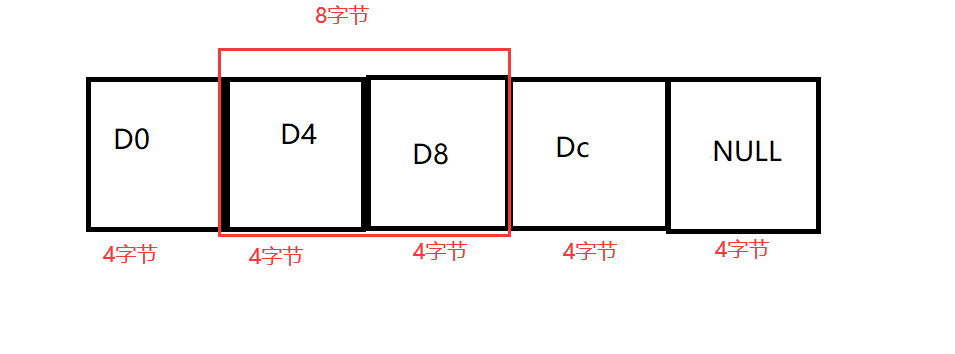
以上图为例,一格黑色方块就是一个 Goo 对象的大小4字节,是提前为未来的 Goo 创建出来的内存空间。理论上来说第一格内存地址为 D0,其 next 指针指向 D4,但是实际运行时由于地址为 8字节,所以第一格的 next 指针的值其实是 D0D4,而这个地址其实是一个未知地址,最后导致运行报错
上述代码其实也很明显,将 Goo 的内存块 cast 成 Obj 对象来管理空闲空间,以此达到节省内存空间的效果。当内存块需要被使用时,其会从空闲链表中移出并设置,此时就与链表无关的,所以也不用管 next 的值。等到 Goo 被 delete 时,其会从 Goo 再次转为 Obj 链表节点,这时也不用管 Goo 对象的值是多少,因为此时 Goo 对象已经无效了
通过上面的 MyAllocator 的内存分配器可以给其他任意类型的对象使用,对象无需再关注内存如何分配,而是仅仅需要引入 MyAllocator 并且在 operator new 和 operator delete 中使用即可
然后稍微使用宏来优化一下
#define  DECLARE_POOL_ALOC()	\
public:							\
	static void* operator new(size_t size) { return myAlloc.allocate(size); }					\
	static void operator delete(void* pDead, size_t size) { myAlloc.deallocate(pDead, size); }	\
protected:\
	static MyAllocator myAlloc;

#define IMPLEMENT_POOL_ALLOC(class_name) MyAllocator class_name::myAlloc;

class Goo {
public:
	long L;

public:
	Goo(long l) : L(l) {}

	DECLARE_POOL_ALOC()
};

IMPLEMENT_POOL_ALLOC(Goo);
如此一来,对于所有的类来说仅仅使用两个宏就可以实现内存池的功能
new handler
当 operator new 无法给你分配出所需的 memory 时,会抛出 std::bad_alloc exception 异常,某些旧的编译器则是返回0
当然你也可以指定不要抛出异常
new(std::nothrow) int;
抛出异常之前会先(不止一次)调用一个可由 client 指定的 handler,下面的带啊吗是 new handler 的形式和设定方法
typedef void (*new_handler)();
new_handler set_new_handler(new_handler p) thro();
实际操作如下
#include <new>

void newErr(void)
{
	cout << "new error" << endl;
	system("pause");
	exit(-1);
}

set_new_handler(newErr);
根据 operator new C++ 源码来看,在 malloc 申请内存失败之后,会调用 _callnewh 函数,该函数就是 call new hanlder 的缩写
这样做其实就是让用户判断一下有没有补救措施,然后再调用一次 malloc ,说不定就成功了
void* __CRTDECL operator new(size_t const size)
{
    for (;;)
    {
        if (void* const block = malloc(size))
        {
            return block;
        }
        if (_callnewh(size) == 0)
        {
            if (size == SIZE_MAX)
            {
                __scrt_throw_std_bad_array_new_length();
            }
            else
            {
                __scrt_throw_std_bad_alloc();
            }
        }
        // The new handler was successful; try to allocate again...
    }
}