
README.md 12 KB
gn
该仓库基于 google 的 gn 仓库进行的翻译
语法
GN 使用非常简单、动态类型的语言
- 布尔类型 (
true、false) - 64有符号整数
- string
- 列表
- 范围(类似字典,只用于内置的东西)
字符串
字符串以双引号括起来,并使用反斜杠作为转义字符
但是反斜杠只支持 \"、 \$、 \\,反斜杠任何其他的用途都会被视为字面反斜杠
"C:\foo\bar.h"这里的\b没有被转义
字符串支持跟随 $ 符号的词被变量的值替换,也可以使用 {} 来替换变量值
以 a = "my_path" 为例
| 写法 | 实际值 |
|---|---|
b = "$a/foo.cc" |
b = "my_path/foo.cc" |
c = "$foo_{a}_bar.cc" |
c = "foo_my_path_bar.cc" |
列表
列表支持增加、删除、索引操作,但是不支持获取列表长度
# 增加
a = [ "first" ]
a += [ "second" ]  # [ "first", "second" ]
a += [ "third", "fourth" ]  # [ "first", "second", "third", "fourth" ]
b = a + [ "fifth" ]  # [ "first", "second", "third", "fourth", "fifth" ]

# 删除
a = [ "first", "second", "third", "first" ]
b = a - [ "first" ]  # [ "second", "third" ]
a -= [ "second" ]  # [ "first", "third", "fourth" ]

# 索引
a = [ "first", "second", "third" ]
b = a[1]  # -> "second"
[] 运算符是只读的,不能用于对列表进行改变,这种i情况的主要用途是当外部脚本返回几个已知值时,可以提取
a = [ "one" ]
a = [ "two" ]  # Error: overwriting nonempty list with a nonempty list.
a = []         # OK
a = [ "two" ]  # OK
条件
if (is_linux || (is_win && target_cpu == "x86")) {
        sources -= [ "something.cc" ]
    } else if (...) {
        ...
    } else {
    ...
}
循环
foreach(i, mylist) {
    print(i)  # Note: i is a copy of each element, not a reference to it.
}
文件名
- 相对名称
"foo.cc"
"src/foo.cc"
"../src/foo.cc"
- 源数绝对名称
"//net/foo.cc"
"//base/test/foo.cc"
- 系统绝对名称
"/usr/local/include/"
"/C:/Program Files/Windows Kits/Include"
构建配置-目标
| 命令 | 作用 |
|---|---|
| action | 运行脚本生成文件. |
| action_foreach | 为每个源文件运行一次脚本. |
| bundle_dat | 一个声明数据进入 MAC/iOS 包. |
| create_bundle | 创建一个 Mac/IOS 包. |
| executable | 生成一个可执行文件. |
| group | 是指一个或多个其他目标的虚拟依赖节点. |
| shared_library | 一个 . DLL 或.SO. |
| loadable_module | 一个 .DLL 或.SO ,只能在运行时加载. |
| source_set | 一个轻量级的虚拟静态库(通常比实际静态库更可取,因为它将更快地构建). |
| static_library | 是.LIB 或.file(通常你需要一个source_set取而代之) |
构建配置-Config
# 定义 config
config("my_config") {
  # 预处理器宏定义
  defines = [
    "USE_FEATURE_X",
    "ENABLE_LOGGING"
  ]

  # 包含目录
  include_dirs = [
    "//include",
    "//third_party/lib/include"
  ]

  # 编译选项
  cflags = [
    "-Wall",
    "-O2"
  ]

  # 链接选项
  ldflags = [
    "-lmylib"
  ]
}
# 将 config 应用到目标
# 引用自定义配置文件
import("//configs/my_config.gni")

executable("my_app") {
  sources = [
    "main.cc",
    "app.cc"
  ]

  # 使用定义的 config
  configs += [ ":my_config" ]
}
为什么上面例子应用 config 时要用 configs += [":my_config"] ?
这里 += 表示向现有的 configs 属性追加 :my_config,保留之前的所有设置。如果直接使用 = 则表示直接覆盖掉之前的配置
为什么应用 config 时要写 :my_config ?
:config_name表示当前文件中的配置//path/to:config_name表示绝对路劲的配置//path/to/configs:config_name表示绝对路径下特定目录中的配置
以下面的路劲为例子
my_project/
├── BUILD.gn
├── config/
│   └── my_config.gni
└── src/
    └── main.cc
在 config/my_config.gni 中定义
config("my_config") {
  cflags = [
    "-Wall",
    "-O2"
  ]
}
在 BUILD.gn 中
# 导入配置文件
import("//config/my_config.gni")

executable("my_app") {
  sources = [
    "src/main.cc"
  ]

  # 正确的使用方式:使用绝对路径或当前作用域
  configs = [ "//config:my_config" ]  # 绝对路径
  # 或
  configs += [ ":my_config" ]  # 当前作用域,假设 my_config 在当前文件中定义
}
假设模块A依赖于某个配置B,希望所有依赖于 A 模块的其他模块都依赖配置 B,这个时候应该使用 公共配置
# 配置B
config("my_external_library_config") {
  includes = "."
  defines = [ "DISABLE_JANK" ]
}

# 模块A
shared_library("my_external_library") {
  ...
  # 所有依赖于这个库的目标都拿到了公共配置.
  public_configs = [ ":my_external_library_config" ]
}

# 其他模块
static_library("intermediate_library") {
  ...
  # Targets that depend on this one also get the configs from "my external library".
  public_deps = [ ":my_external_library" ]
}
构建配置-模板
template 㻾创建自定义的符合构建目标。通过定义模板,可以将一组常用的构建配置封装起来,然后再多个地方复用,减少重复代码并提高构建文件的可维护性
# 定义 template
# my_templates.gni

template("my_executable_with_tests") {
  # 定义模板参数
  declare_args() {
    sources = []
    test_sources = []
  }

  # 创建可执行文件目标
  executable(target_name) {
    sources = sources
  }

  # 创建测试可执行文件目标
  executable(target_name + "_test") {
    sources = test_sources
    deps = [ ":$target_name" ]
  }
}
使用 template
# 引用模板文件
import("//path/to/my_templates.gni")

# 使用模板来创建构建目标
my_executable_with_tests("my_app") {
  sources = [ "main.cc", "app.cc" ]
  test_sources = [ "app_test.cc" ]
}
模板的第一个参数会被用作 target_name,即目标名称。所以 template 中定义的 target_name 对应的就是 my_app
除了定义之外,template 中还能定义 条件判断、循环、嵌套模板
# templates/my_templates.gni

template("my_executable_with_tests") {
  declare_args() {
    sources = []
    test_sources = []
    use_optimization = false
  }

  if (use_optimization) {
    config("optimization_config") {
      cflags = [ "-O2" ]
    }
  }

  executable(target_name) {
    sources = sources
    if (use_optimization) {
      configs += [ ":optimization_config" ]
    }
  }

  executable(target_name + "_test") {
    sources = test_sources
    deps = [ ":$target_name" ]
  }
}
交叉编译
注意
注意路径中不要出现中文,否则可能会出现莫名其妙的错误
样例
Hello-GN
通常来说
- 项目中会有一个
.gn文件
.gn 文件是项目的入口文件,该文件会依赖其他的配置文件, gn 会逐级加载这些被依赖的配置文件。依赖项加载完毕之后,再从项目的根目录开始逐级加载所有 .gn 结尾的文件
根目录中的
BUILD.gn文件所依赖的其他的其他文件会被加载
- 项目中可能存在多个
BUILDCONFIG.gn文件
通常来说 BUILDCONFIG.gn 是一个特殊文件,通产用于定义全局构建配置、设置默认值、全局变量等,这些配置可以被项目中的其他 BUILD.gn 文件引用
| 作用 | 代码 |
|---|---|
| 定义全局变量 | declare_args() { is_debug = false } |
| 设置默认值 | 定义默认的编译器选项、链接器选项等 |
| 导入公共配置 | import("//build/config/compiler.gni") |
| 配置工具链 | toolchain("win") { } |
| 定义构建逻辑 | if(is_win) { } |
常见变量
| 变量 | 含义 |
|---|---|
| os | 操作系统 |
| cpu | 处理器 |
| host | 编译时的主机 |
| target | 目标平台 |
| current | 当前配置 |
常见配置写法
if (target_os == "") {
  target_os = host_os
}

if (target_cpu == "") {
  if (target_os == "android") {
    target_cpu = "arm"
  } else {
    target_cpu = host_cpu
  }
}

if (current_cpu == "") {
  current_cpu = target_cpu
}
if (current_os == "") {
  current_os = target_os
}
- 项目中会有一个
build\toolchain文件夹,里面存放着BUILD.gn
构建项目的结构是项目根目录的 BUILD.gn 文件
executable("hello") {
    ...
}

shared_library("hello_shared") {
    ...
}

static_library("hello_static") {
    ...
}
在 build\toolchain\BUILD.gn 中定义了工具链
toolchain("gcc") {
    tool("cc") { ... }
    tool("alink") { ... }
    tool("solink") { ... }
    tool("link") { ... }
    tool("stamp") { ... }
    tool("copy") { ... }
}
在 GN 中,工具链(toolchain)和工具(tools)的调用是通过目标类型(如 executable、static_library、shared_library 等)和默认配置来自动处理的
编译 C/C++ 源文件时会自动调用 cc 工具,链接静态库时会调用 alink 工具,链接共享库时会调用 solink 工具,生成可执行文件时会调用 link 工具
| 命令 | 工具 |
|---|---|
executable |
cc、link |
static_library |
alink |
shared_library |
solink |
source_set 或 group |
stamp |
在 BUILDCONFIG.gn 中通过 set_default_toolchain("//build/toolchain:gcc") 设置默认工具
案例2
BUILD.gn 一般作为模块的工程入口文件,可以配合 .gni 文件来划分源码或模块
.gn 根文件是一个入口设置的文件,是 GN 中的固定规则文件,会自动被 GN 读取
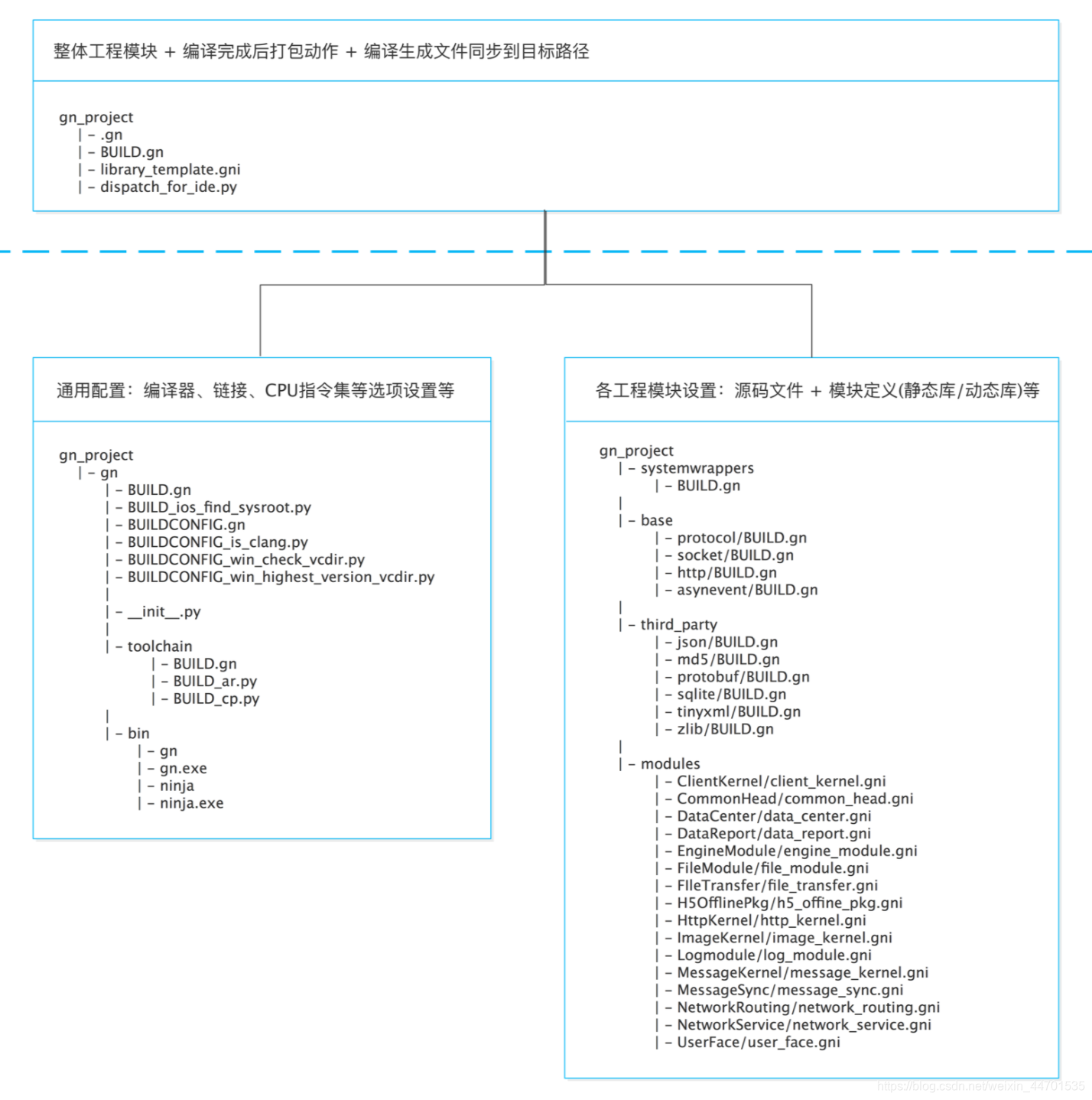
一般 GN 组织一个跨平台工程分为三大块
- 整体工程入口,一般不经常修改
- GN 通用文件,一般不经常修改
- GN 源代码工程文件,这部分与平常在继承开发环境中类似,源文件的组织和管理就在这部分
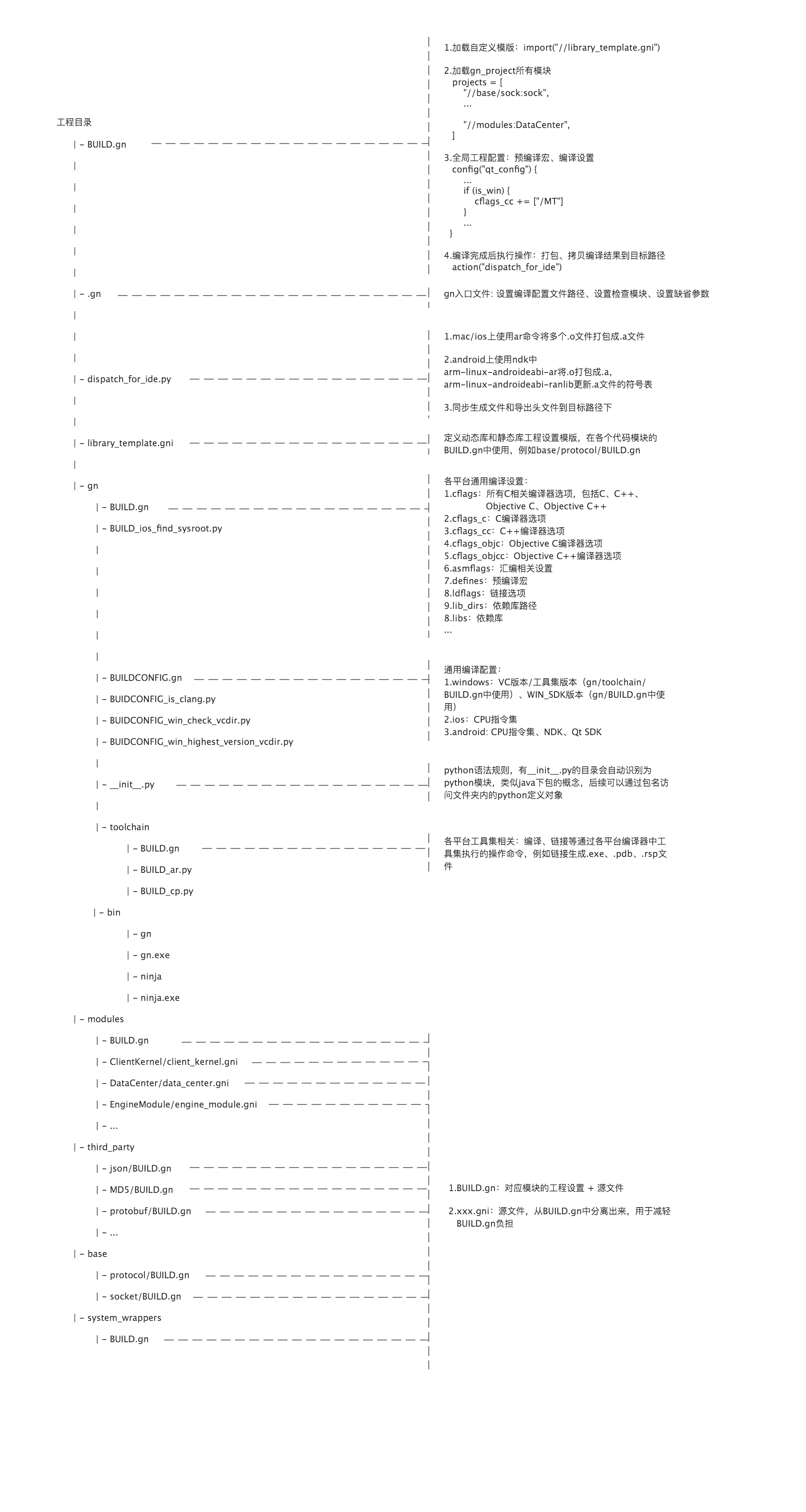
各个 GN 文件的作用
以根目录的 BUILD.gn 为例
if (!is_test) {
    group("ccore"){
        deps = projects
        deps += [ "//:dispatch_for_ide" ]
    }
}

action("dispatch_for_ide") {
    arg = [
        "--kernel", rebase_path("//"),
        "--outpath", rebase_path("//out"),
        "--cachepath", rebase_path("$root_out_dir"),
    ]

    if (is_debug) {
        arg += [ "--buildmode", "Debug" ]
    } else {
        arg += [ "--buildmode", "Release" ]
    }

    arg += ["--targetcpu", "${target_cpu}"]

    script = "dispatch_for_ide.py"
    outputs = [ "$root_out_dir/libccore_gn.a" ]
    args = arg
    deps = projects
}
action 目标是定义自定义构建步骤的一个机制。它的执行时机和调用方式依赖于它在构建图中的依赖关系
比如上述代码定义了名为 dispatch_for_ide 的 action,该 action 在 group("ccore") 被依赖,所以当 ccore 被执行时会执行该 action
script字段指定了要执行脚本为dispatch_for_ide.pyoutputs字段表明了会输出哪些文件,通过outputs和sources可以明确action之间的依赖关系,从而决定执行顺序args定义了执行脚本时会传入的参数,可以通过if-else添加不同的命令参数deps该action的依赖项,会先进行依赖项
if (is_win) {
    set_sources_assignment_filter([
        "*_posix.h", "*_posix.cc",
        "*_mac.h", "*_mac.cc", "*_mac.mm",
        "*_android.h", "*_android.cc",
        "*_jni.h", "*_jni.cc",
    ])
}
source_set:编译后的代码集合,它与静态库的唯一区别时灭有链接的符号文件,就是一遍编译后生成的 .i 文件static_library:静态库,windows 上是 lib 库,其他平台是 .a 库shared_library:动态库,windows 上是 dll 库,Android 平台是 .so 库, mac 和 IOS 是 dylib 库